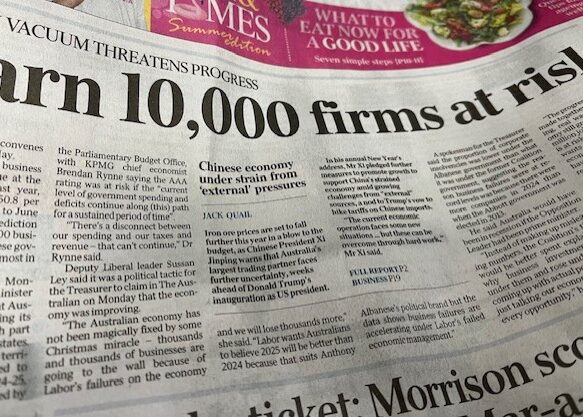
Increases or decreases in the number of insolvencies in Australia are used, particularly now, as some sort of political weapon indicating government economic mis/management, and in order, perhaps, to sell ‘news’papers. See The worst is still to come! apparently – Murrays Legal
The Reserve Bank’s Financial Stability Review of April 2025 provides an informed and objective analysis on the resilience of the Australian financial system and as one aspect of that, gives us an informed account of insolvency numbers and their relative economic significance.
Financial Stability Review
The Review reports on a wide range of risks to the Australian financial system – business, household and commercial – including geopolitical, cyber and climate change risks. This comment selects only particular issues from the report.
As to risks to the financial system from lending to households, businesses and for commercial real estate, these risks remain contained. Budget pressures have eased a little for some and the share of borrowers experiencing severe financial stress remains small, and the number of households experiencing severe financial stress remains very low, all reflecting the continued strength in the labour market and the maintenance of prudent lending standards.
The Recent Increase in Company Insolvencies and its Implications for Financial Stability
Focus Topic 4.3 of the Review, The Recent Increase in Company Insolvencies and its Implications for Financial Stability, examines the characteristics of firms that have recently entered insolvency, the factors that have caused them to become insolvent, and the implications for financial stability. It notes that insolvency is the most severe form of financial stress for a business and that it can occur for a variety of reasons but that it affects only a very small share of businesses in a typical year.
Currently, while the number of companies entering insolvency has risen sharply, they remain small as a share of businesses. Around 0.5 per cent of businesses entered insolvency during 2024 – a rate that is at the top of the range observed in the 2010s but on a cumulative basis, company insolvencies remain slightly below their pre-pandemic trend. The increase reflects challenging trading conditions and the removal of support measures introduced during the pandemic, including the ATO’s resumption of enforcement actions on unpaid taxes.
More than three-quarters of recent insolvencies have been small businesses, defined as less than 20 employees. Many unsecured creditors have incurred losses, with suppliers and contractors rarely recovering funds from external administrations.
Banks have had limited exposure to businesses that have entered insolvency. Their non-performing loan rates remain low and most companies entering insolvency have no outstanding secured debt hence the risk of widespread asset fire sales is limited.
Construction insolvencies increased sharply in 2023 due to supply-side challenges, as did industries exposed to discretionary spending, notably hospitality. Hospitality firms are especially vulnerable to changes in demand, as they typically operate with slimmer profit margins and limited cash buffers.
Employees
The indirect effects of insolvencies on employees have been limited by the small size of insolvent companies – most have less than 20 employees, and the strength of the labour market. And more than 90 per cent of individuals who were working for an insolvent firm in the year leading up to the insolvency have been re-employed by another business within a few months or have been retained. These individuals have been able to recover their pre insolvency earnings within a year.
Most businesses remain profitable and resilient
Most businesses continue to be profitable and resilient to shocks.
Most large and small businesses’ profit margins are around the level recorded over the 2010s. Many have achieved sufficient revenue growth to offset increased labour and non-labour costs over the past year or so. Experiences vary across businesses, with a sizeable number of particularly smaller businesses making losses, although this is not unusual.
Early indicators of financial stress have stabilised or improved and pressures on businesses’ cash flows are expected to ease.
The future
The future path for insolvencies is highly dependent on how economic conditions evolve, though some factors will put upward pressure on the insolvency rate in the months ahead. Insolvencies are yet to return to the pre-pandemic trend in several industries, suggesting there may be more catch-up to past levels given the exceptionally low number of insolvencies during the pandemic.
While business’ cash flow pressures are expected to ease, these will not necessarily translate into a lower level of insolvencies in the near term due to the lag between entering financial stress and insolvency.
Nevertheless, risks to the financial system are expected to remain contained. Smaller firms continue to be more at risk of insolvency as they are more vulnerable to the current challenging conditions than larger firms. Should more medium- or large-sized businesses enter insolvency, lenders’ exposures would likely increase.
Personal insolvencies
The Bank’s analysis is limited to company insolvencies and excludes business-related personal insolvencies. This is odd given the significant proportion of small businesses operating outside a company structure. As the 2023 PJC Report said, even if a company is used, there is an intertwining of company and personal debt of the owners, through personal guarantees, tax liabilities and the owners’ use of their personal funds to support the business. AFSA’s State of Personal Insolvency Report released for 2024 | Australian Financial Security Authority provides useful information, as does the ASBFEO – ASBFEO Small Business Pulse | ASBFEO.
In any event, numbers of personal insolvencies have fallen dramatically, over 40% in the last 5 years, from over 21,000 in 2019-2020 to around 12,000 in 2024-20. As the Review says, personal insolvencies remain significantly below historical averages.
The plus side
The Report does give a negative economic view of insolvencies, in not at least acknowledging that insolvency serves a purpose of removing insolvent businesses from the marketplace, relieving pressure on the business owners, and in some cases, restoring the financial viability of a business through a restructuring process.
Insolvency numbers
In the end, there’s not much of a story here about insolvency numbers, while at the same time acknowledging what can often be the personal, business and economic distress and disruption involved.
==============================================