
England’s approach to ‘phoenixism’ – joint and several liability
English law’s latest proposed reforms in relation to abuse of its tax laws through insolvency, including through ‘phoenixism’, seem to show its regime as less

English law’s latest proposed reforms in relation to abuse of its tax laws through insolvency, including through ‘phoenixism’, seem to show its regime as less

The Ministers for Consumer Affairs of Australia and New Zealand recently met, on 26 October 2018 in Melbourne, making a range of significant decisions about

The law reform process of going through a piece of legislation and picking up minor errors is useful and necessary but can be unwise. What
Articles on this website generally attract reduced readership if they are about bankruptcy rather than liquidation; or if they are about overseas law rather than

ASIC has released its new Report On Company Activities and Property (ROCAP), said to have been the result of an ‘extensive revision process and industry

Under s 136(1)(ca) of the ASIC Act, ASIC is required to report in its annual report on its activities under Chapter 5 and Schedule 2

This UK government consultation concerns new arrangements proposed for a 60 day ‘breathing space’ for struggling debtors, and for a separate statutory ‘debt repayment plan’.

It now seems that an old elephant in the room – about the misconduct of banks and financial institutions – has been revealed by the

The UK government has announced in its 2018 budget that priority dividend payments will be made to the revenue for certain unpaid taxes of a

The Corporations and Markets Advisory Committee (CAMAC) was a corporate law reform body comprising individuals eminent in that field. It was created in 1983 and

The Australian Academy of Law is presenting this session hosted by Curtin University Law School on 8 November 2018 in Perth, at 5.30pm, presented by

ARITA advises that it can now ‘begin conduct proceedings [against its members] based on evidence reported in the media’. Murrays Legal only reports matters substantiated
Lawyers’ fees in class actions were the subject of a recent conference[1] paper by Sir Rupert Jackson, given in Melbourne, whose report in the UK

Research just published[1] has looked at the relation between board turnover and the likelihood that a company that enters a deed of company arrangement under

ASIC’s submission[1] to the Australian Law Reform Commission on class actions and litigation funding seemed to be a surprise to some.[2] ASIC says that, consistent

The Senate Committee inquiry into debt management firms comes at an odd time, given pending regulation of such services by the new Australian Financial Complaints
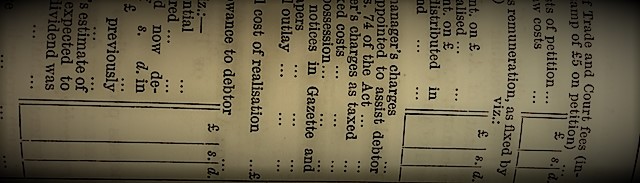
The long history of the report as to affairs in corporate insolvency – the RATA – which started about 1890, has now ended, in 2018.

Registered clubs all over the country get into financial trouble, sometimes requiring the formal insolvency processes under the Corporations Act to secure their position, and

The World Bank has come out with reports[1] that support the Australian government’s attempts to control unlawful phoenix activity, by way of the creation of

An interesting aspect of ASIC’s forthcoming 2018 annual report will be its review of the operation of the changes brought in by the Insolvency Law

Most bankruptcies pay nothing to unsecured creditors. But there are only limited circumstances where a debtor can resist bankruptcy by claiming that they have nothing.
The need for universities to maintain and encourage open debate, particularly in matters of controversy, was recently the subject of a talk for the Academy

Those who are owed “unclaimed moneys” arising from a bankruptcy – for example a creditor whose dividend payment went astray – are assisted by recent
Ten years ago, on 15 September 2008, Professor Rosalind Mason of QUT Brisbane and I gave a paper at the INSOL Academics Group Meeting in