
‘In the ordinary course of business’ in insolvency – why are we following wrong thinking New Zealanders?

The term ‘ordinary course of business’ in law is meant to describe a transaction that was within the normal operations of a particular business, it being an aspect of a defence to a liquidator’s or trustee’s challenge to that transaction. It became so difficult to apply in particular corporate insolvency cases that it was repealed, […]
Choosing practitioners to administer Australian MSME insolvencies

The Australian government is presently finalising its draft SME insolvency law reform proposals. Apart from getting the law right, as significant a task is deciding who should administer it. The government has proposed a widening of the existing registered liquidator group and its now has submissions opposing or supporting that. The history of professional groups […]
Who wants to be an SME insolvency practitioner? Australia’s proposed reforms

Australia proposes to follow England’s lead in giving insolvency practitioners the initial role in new debtor in possession insolvency reforms, but in rather different ways.[1] In the UK, the ‘monitor’ role introduced by the Corporate Insolvency and Governance Act 2020 is designated for licensed insolvency practitioners (corporate and personal) but there is power in the […]
Australia’s proposed MSME insolvency reforms – an international perspective

Australia’s draft legislation to implement its announced MSME corporate insolvency reforms may have drawn more on international than local thinking, in particular in relation to the debtor in possession model long resisted in Australia. The proposed reforms compare reasonably well with international guidance which is in the process of finalisation through UNCITRAL’s insolvency Working Group […]
Coronavirus safe harbour – beware the claytons waterfall in s 588GAAA
It is interesting to now see the clear limitations the government has placed on the protections offered by the COVID-19 ‘safe harbour’ reforms, in the latest extension of time of the operation of s 588GAAA Safe harbour–temporary relief in response to the coronavirus to 31 December 2020. The limitation is that unless the company in question […]
“industry codes with their precepts, guidance and aspirational verbiage cannot dictate the proper construction and application of the relevant statutory provisions”

Soft law in Australia takes a rather strict approach in assessing the independence of insolvency practitioners, more so than, for example, the UK: for a recent example, see Re Nationwide Accident Repair Services Ltd & Ors [2020] EWHC 2420 (Ch), a pre-pack. But as I have said, the law itself as applied by the Courts […]
Duties of directors of insolvent companies – New Zealand Supreme Court decision

The NZ Supreme Court has given a significant decision on the duties of directors in the face of their company’s financial difficulties. Comparison is made by the NZ government with Australia’s insolvent trading law; a decision in Mainzeal is pending; and there is a proposal for a NZ safe harbour. When Australia was considering […]
Fightback! SMEs get a new restructuring tool

The federal Treasurer has announced a new restructuring regime for struggling small to medium enterprises (SMEs)[1] which adopts a ‘debtor-in-possession’ model for companies owing less than $1 million. There is already much comment about the government’s announcement of major changes to Australia’s corporate insolvency laws. We don’t propose to comment on them in detail – […]
Under the Trans-Tasman Mutual Recognition laws, licensed New Zealand insolvency practitioners should be able to practise in Australia …

New Zealand has a new insolvency practitioner regulation regime which commenced on 1 September 2020. The regime has processes allowing Australian registered liquidators to be registered and to practise in New Zealand. See my Insolvency licensing bodies confirmed for New Zealand’s new regulatory regime I am not aware of anything issued in Australia as to […]
A health check of the Australian corporate insolvency system – updated

Commentary following issued in April 2020 is reissued in September 2020 in light of the reports that a significant proportion – close to 55%* – of the insolvency industry is on government assistance. While the collapse in the numbers of insolvencies is a reason, Macquarie Bank’s Report on the health of the insolvency practitioner industry […]
Insolvency protections extension to 31 December 2020

The Corporations and Bankruptcy Legislation Amendment (Extending Temporary Relief for Financially Distressed Businesses and Individuals) Regulations 2020 serve to extend the existing insolvency protections to the end of Thursday 31 December 2020. This includes extending the COVID-19 safe harbour protection to that date.
UK’s plan to give great access to corporate data, beneficial ownership etc

In What has happened to the proposed beneficial ownership of shares register? in February 2020, I asked what has happened to the Australian government’s ”First Open Government National Action Plan” of 2016, including a proposed beneficial ownership of shares register? It seems not much? The UK Meanwhile, the UK government has given its positive response […]
A 2012 committee of creditors found in 2020 to be invalidly appointed

In May 2012 a national Australian transportation company was put into liquidation and on 2 July, a meeting of creditors was held which purported to appoint a committee of inspection (creditors) and specify the members of the COI. ‘Purported’ because over 8 years later, the appointment of the committee has been found to be invalid: […]
A “private arrangement” between a liquidator and the Tax Commissioner

The Commissioner of Taxation has purchased a litigation claim from a liquidator, on what terms we are not permitted to know. One of the reforms introduced in Australian in 2017 was to allow liquidators and trustees to assign causes of action to a third party, including a creditor, for value: s 100-5 Schedules. The idea […]
INSOL’s report on practitioner remuneration – another perspective

There is more to insolvency practitioners’ (IP) remuneration than is usually presented, and this commentary explains relevant issues not generally addressed, and in a broader perspective. It is partly prompted by INSOL International’s August 2020 report on remuneration. IP remuneration is typically said to be all about: ensuring their remuneration claims are proper and necessary, […]
UK gearing up for major corporate liquidations in ‘unpredictable times for the insolvency sector …’

In what appears to be ominous but necessary preparation for the continued economic consequences of COVID-19, the UK Insolvency Service is seeking insolvency practitioner firms to take on the role as special managers under the Insolvency Act 1986. A Special Manager Panel is being established to support the Official Receiver in the complex insolvencies to […]
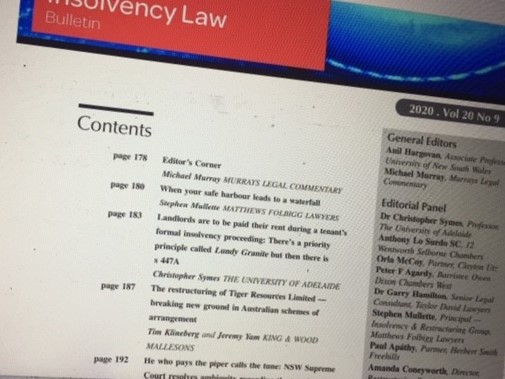
Insolvency Law Bulletin – safe harbour, Tiger Resources, Virgin and who’s the employer
The latest Insolvency Law Bulletin contains a warning about the (then) ending on 24 September of the COVID-19 protections, now since extended to 31 December. As Stephen Mullette explains, assisted by his musico-literary allusions, the drafting of the March 2020 Omnibus Act is rather strict, requiring any company seeking to have special safe harbour protection […]
Bankruptcy and family provision claims

In Bankrupt for Life, concerning the way a person can remain bankrupt for ever in Australia if they never file their statement of affairs (SOA), I referred to the case of a Mr Talent, who was made bankrupt in May 2000 but who had only filed his statement of affairs over 20 years later, in […]
Some parliamentary reminders for ASIC’s 2020 annual report

The 1 September 2020 report of the Parliamentary Joint Committee on Corporations and Financial Services on the 2018–2019 annual report of ASIC has pointed out that ASIC failed to fulfil its annual reporting responsibilities sections 136(1)(ca) and 136(1)(cb) of the ASIC Act. These sections require ASIC to explain what activities it has undertaken in relation […]
Extension of the COVID-19 insolvency protections – what’s the real problem?
The Australian government has extended the monetary threshold of A$20,000 for the commencement by creditors of bankruptcy and liquidation proceedings and the 6 month periods for compliance, to 31 December 2020. It has also extended the special COVID-19 ‘safe harbour’ protection for the same period. This has prompted an outcry of objections to the extensions. […]
Courts ‘should be wary of [liquidator] disclaimers where environmental liabilities are to be passed onto taxpayers or innocent persons’

A court has set aside liquidators’ disclaimer of contaminated property on a challenge by the environmental regulator. Particularly in a voluntary liquidation of a company, the Court said it should discourage the use of that process as a means to avoid the company’s environmental responsibilities. Ultimately however, environmental responsibilities are better enforced earlier, than at […]
Corporate Criminal Responsibility – final ALRC report

The Australian Law Reform Commission report, Corporate Criminal Responsibility (ALRC 136), was tabled in Parliament on 31 August 2020. The 20 recommendations made seek to ‘significantly strengthen and simplify the Commonwealth corporate criminal responsibility regime’. A question will be whether this ALRC 136 report will receive better legislative attention than the more substantial ALRC 95 […]
Insolvency licensing bodies confirmed for New Zealand’s new regulatory regime

The New Zealand Registrar of Companies has approved the first licensing bodies for the commencement of the new regulatory regime for its insolvency practitioners on 1 September 2020. This will require insolvency practitioners operating in New Zealand to be licensed by an accredited body. NZICA and RITANZ The Registrar has approved the New Zealand Institute […]
Insolvency and debtor in possession – hospital or home care?

If Joe thought he might have a serious medical condition, but did not want to go to hospital for a period of some weeks to have it fixed, like many, Joe would hesitate to even seek advice. It may be nothing and it will resolve itself. If there were another option, that the condition could […]