Among other law reform ideas, I have been writing about the need for an Official Receiver role in corporate insolvency for some time – ok, over 10 years at least.
As well, Jason Harris and I have raised it in several editions of Keay’s Insolvency, and at international and local conferences, and in our article, Rebuilding the structure of the Australian insolvency system (2022) 22 INSLB 14.
Such a role is now recommended in the interim report of the Productivity Commission in its inquiry into business dynamism, dated 5 November 2026, following on from discussion of the idea in the 2023 PJC Report.
What is proposed
It is too early to assess what may be proposed. There are constitutional issues and the states may need to be involved.
But the idea is more significant than being a statutory government role in corporate insolvency in that the role could or should cover both personal and corporate insolvency. That is the case in the UK and New Zealand.
Significantly, AFSA and the Official Receiver and Official Trustee provide a range of administrative services from issuing bankruptcy notices, s 139ZQ notices and conducting examinations. Challenges to a trustee’s objection to discharge are heard by AFSA and a trustee’s remuneration can be determined by AFSA. Of course there are AFSA’s responsibilities extending into administering bankrupt estates.
In comparison, any such tasks are dealt with by the court, in particular a remuneration determination. Even the role of a reviewing liquidator exists in default of an official receiver.
Such a role could readily facilitate the intersection between personal and corporate insolvency, removing the present barriers.
More than last resort
In its estate administration role, the PC has referred to it as being one of last resort, which may come from an industry preference and may not be the best option.
The UK Official Receiver is of first resort in the UK in the sense that it takes on major insolvencies where there is significant risk, that private firms are unwilling to take on – British Steel was one; or where there are public interest issues, like Thomas Cook.
In any event, even if it would have the potential to intrude upon private liquidators’ work, as I recently said, a profession will accept that if the reform is in the public interest.
Why doesn’t Australia already have one? UK, NZ and Singapore do
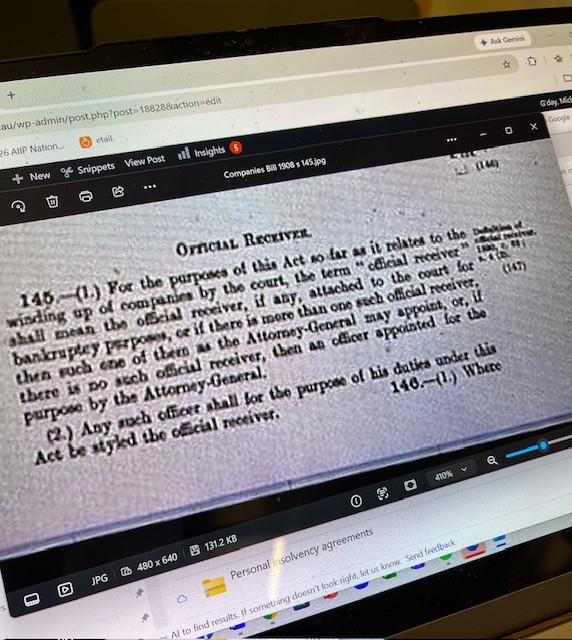
When all the new laws were being drafted into bills after federation these included a Bankruptcy Bill 1908 and a Companies Bill 1908. Each provided for an official receiver and that became the reality when the Bankruptcy Act 1924 commenced operation.
Companies Bill 1908
In the Companies Bill 1908, clause 145 provided that the term “Official Receiver” (OR) is to mean
“the OR, if any, attached to the Court for bankruptcy purposes”.
Section 146 gave the directors 14 days to file a statement of affairs with the OR.
Under s 147, the OR was to report to the court on the winding up as soon as practicable.
And so on.
However even before the Companies Bill had been introduced into parliament the High Court gave a decision in 1909 which severely curtailed the power of the Commonwealth in respect of corporations: Huddart, Parker v Moorehead[1] the end result of which was that the Commonwealth withdrew further work on the bill and left it to the states. That meant that each state enacted their own laws for companies, including their insolvency. That continued up until the commencement of the federal Corporations Act 2001.
Official liquidators
Before 2001, arrangements for an “official liquidator” developed in the states being a private practitioner who would accept all estates even if assetless but who otherwise receive priority in respect of large estates[2] – the “good with the bad”.[3] The number of official liquidators appointed was also limited in order to ensure their adequate remuneration.
Nevertheless, by the 1970s around 70% of official liquidator appointments were to assetless companies. A comment in 2006 was that “the present regime is not viable in the medium to long term”.[4]
Various findings confirmed the shortfall in remuneration, to the extent of $45m+ per annum, funded by cross-subsidisation, which itself came under scrutiny.
ILRA 2106
In 2016 the government did away with that official liquidator role, under the ILRA 2016.
In the Explanatory Memorandum to the ILRB 2015, at [9.137], it was explained that following the removal of any obligation to administer assetless estates, creditors would need to make provision for the liquidator’s remuneration.
“This may mean a reduction in the number of assetless companies liquidated as corporate insolvency practitioners would not be expected to commence such administrations without some form of guarantee or where they do not believe they are likely to be remunerated”.
However, there was concern expressed that many of these companies that disappear by default might be the result of phoenix activity but they are unexamined or investigated by anyone. Their numbers were said to be five times as many as those formally administered under Ch 5. The abuse of the deregistration process for phoenix activity was said to go back to at least 1995.
The 2023 PJC Report and the PC inquiry
The 2023 PJC Report recommended [10] that ASIC
“collect and analyse data from an appropriately sized sample of voluntary and compulsory deregistrations, to provide greater visibility of the solvency status of deregistered companies”.
We are yet to hear though the PC may initiate some inquiry.
The government’s response of 6 August 2026 was simply that it notes the PJC recommendation and it encouraged ABRS, ASIC and ATO to collaborate to undertake an analysis using information available to each agency. No doubt these three will have regard to the findings of the $400,000+ federal government research project that alerted us to these concerns back in 2015.[5].
New Zealand
NZ has been mentioned. The NZ Official Assignee conducts corporate insolvencies alongside the private sector, with some concessions.
Section 254 of the Companies Act 1993, provides that, in the case of assetless companies, the Official Assignee is not required, without Ministerial consent, to carry out any duty or exercise any power in connection with the liquidation if, to do so, would or would be likely to involve incurring any expense.
But the major difference there is that personal insolvency is seen as so imbued with the public interest, that its work is not available to the private sector – the Official Assignee takes all.
Next
The PC is asking for submissions on this and other issues in its interim report by 11 December.
While Jason Harris and I gave some analysis of the figures in our 2022 article, concluding that the system was in effect broke, no doubt a current accounting analysis could be done, a special purpose liquidator is one idea.
================================
[1] Huddart, Parker & Co Pty Ltd v Moorehead [1909] HCA 36; (1909) 8 CLR 330. That concern has continued, see New South Wales v Commonwealth (1990) 169 CLR 482 which held that s 51(xx) only allowed the Commonwealth to make a law regulating the activities of corporations already in existence; ie, the words “formed within the Commonwealth” meant “already formed”.
[2] D Cowling, What’s in a name? Is it official? (2006) A Insol J 4
[3] Brian Cassidy Electrical Industries Pty Ltd v Attalex Pty Ltd (No 2) (1984) 9 ACLR 289.
[4] D Cowling at 8.
[5] https://dataportal.arc.gov.au/NCGP/Web/Grant/Grant/DP140102277