Family disputes can be very unpleasant and perhaps in particular when they arise from family members being left out of a will or there are other claims to the deceased’s property.
In Whittorn v Siu [2026] NSWSC 666 (11 June 2026) the deceased father had left all his property to his de facto spouse – “P” – following the separation and divorce from his wife, the mother of his three sons. He had discussed his will with his sons before he died.
Justice Michael Meek thought that they could resolve their differences, being not that far apart.
“However, regrettably that is not the case and instead, the parties, unable to collectively muster enough goodwill or trust to resolve their differences, have left the matter in the hands of the Court to decide their rights …”.
The parties had spent $300,000 on their dispute.
Deciding upon these matters would be a difficult task for any Judge, with conflicting and also much personal evidence, and cross-exmination.
(One point for lawyers, a fairly obvious but unusual one, is the Judge’s warning about paralinguistic conduct of persons in the court while evidence is being given, such as for example shaking of the head, scoffing or rolling of the eyes, or other such vocalics).
A deep analysis of aspects of the human condition and behaviour
In setting the background to such a matter, we would not usually see such a deep analysis of aspects of the human condition and human behaviour as in this judgement of Justice Meek. The concept of trust is central.
The judgement is very long, it was heard over several days and took nearly a year to decide. It contains analyses of the human mind referenced according to various authorities. It also contains alleged conversations within the family about the father’s decision and includes a long emailed communication by one of the sons to his father in quite emotional terms asking why such a decision had been made.
Citations
The list of citations includes
- The Oxford Handbook of Social Epistemology,
- Agatha Christie’s Endless Nights (the 1967, New York: Pocket Books edition),
- John Donne’s Devotions (Upon Emergent Occasions, and several steps in my Sickness) (1840) Meditation XVII), and “No man is an island, entire of itself; every man is a piece of the continent, a part of the main”,
- Ralph Waldo Emerson’s ‘Man the Reformer’ (his lecture given to the Mechanics’ Apprentices’ Library Association on 25 January 1841), and
- Grahame Green’s “But it is impossible to go through life without trust: that is to be imprisoned in the worst cell of all, oneself”,
apart from the standard Cheshire and Fifoot, Megarry and Baker’s Snell’s Principles of Equity (24th ed, 1954), Rares and Rares on the Law of Estoppel, and other texts, as well as songs by Marvin Gaye and Taylor Swift.
The judgment
It is an interesting read some extracts following, paraphrased, footnotes omitted.
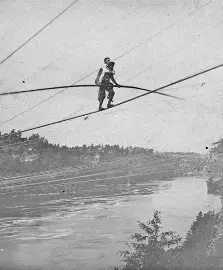
“On 15 September 1860, the astounding French tightrope walker Jean François Gravelet, more widely known as Charles Blondin, crossed Niagara Falls carrying his manager Harry Colcord clinging on his back[1]. The feat was performed across a lengthy span, at great height above the falls, and reputedly without centre guy ropes[2]. It exemplified courage, risk, and relevantly the extraordinary trust of one person in another, even with their life.
Questions of trust and lack of trust or loss of trust pervade the essential facts of the case, involving Neil Raymond Whittorn (deceased) and the parties (3 persons closely connected to him) in respect of their claims regarding a unit/apartment at Thomson Street[3], Tweed Heads, NSW (Property) currently registered in the name of the defendant.
The parties are the deceased’s two sons, Timothy Mark Whittorn (Timothy) and Christopher Lee (Christopher) (collectively the plaintiffs), and Supaporn Siu (defendant or Ped) – who formed a relationship with the deceased from about 2013 and claims to have been his de facto spouse.
None of the parties financially contributed to the deceased’s acquisition of the Property – it was paid for solely by the deceased.
‘A matter of trust’
Trust in the ordinary sense is relational among people or between a person(s) and a thing.
What engenders trust and what may lead to loss of trust, is the subject of phenomenological studies[6], social epistemological review[7] and other objective scientific research[8].
…
To greater or lesser degrees, all humans must trust somethings or some others. Individuals affect others and are shaped by a myriad of trust relationships.
Yet broken trust or betrayal between people, especially couples, lovers, friends, and family can be profound, and must not be trivialised or underestimated in its repercussions. Its effects are rarely quarantined. …..
People are modelled trust in their rearing and upbringing, significantly through life with family and friends. …”.
Music and Piccolos
The Judge refers to the aspects of trust in opera libretto and popular music lyrics – ‘Truth and Honesty’ – Aretha Franklin; Mozart’s ‘The Magic Flute’, and ‘I Heard It Through the Grapevine’ by Marvin Gaye.
And that while some people are generally steadfast in character and often very predictable, there are exceptions as Justice Meek explains,
“the wonted coffeeholic who ‘invariably’ orders a piccolo might occasionally order a ristretto or a cappuccino”.
Trust
The Judge then gets to the particular point, that “trust and mistrust have a particular role and effect where property or wealth is involved”, referring to Agatha Christie’s “…Where large sums of money are concerned, it is advisable to trust nobody”.
“Unable to resolve their differences in some way that is acceptable to each other, the parties have collectively spent in excess of $300,000 litigating over the Property and their claims to it”.
Some evidence
A conversation with dad
“In or about December 2019, my father sent a copy of the Will to me. I recall we had a conversation about it shortly after I received it, with words to the following effect:
Dad said: “Are you happy with my will?”
I said: “Is this what you really want? This is not what you have previously told. You told me that you wanted your estate to come to Chris and I, and ultimately to your grandchildren”
Dad said: “When I am attending at the solicitors P is always there and sits in on all the meetings. She was there when I gave my Will instructions and on the day, I signed it in November. She knows the contents. You know what women are like son.
After we left the solicitors P started shouting at me saying I am not happy, you give me nothing, who will look after me. If you will not look after me, I will leave you. You need to look after me, I need to be safe.”
.. “P said she would leave me unless I promised to do what she wanted and look after her. I was very upset by her behaviour, but it was not the first time she made this threat or walked out If she didn’t get her own way”.
The email from the son to his father
Dear Farther,
This morning i opened your will and was very surprised, concerned, hurt and upset.
I don’t understand what your intentions are with this Will?
Ever since i was was (sic) alive l have memories of you being my best friend. You were always by my side. You taught me everything from eating to tying my own shoelaces to appreciating the beauty of life itself. You supported my football at Olinda training n 2c and having warm chocolate milks after training. You too me to Basketball training in the Hall. You taught me the way to walk to school and gave me my appreciation for exploring and enjoying my young life. You took us camping in the grampians each year. We went rabbi fishing. I learned that you fish for red fin in the same damn. We use to each grass hoppers and fly kites. I remember you teaching me how to rake my first pile of leaves and chop me first bit of wood. zylou taught me how to skim rocks and cross bussy roads safely at safety beach. You taught me how to swim and gave me appreciation I ante have of water that being ocean and surfing. You taught me how to ride a bike and how to hit the trees when I fell off. …”: as written.
Outcome
The outcome: see Whittorn v Siu [2026] NSWSC 666 (11 June 2026)