
Moving away from cricket [below, 2025], High Court Justice Robert Beech-Jones’ recent speech – Griffith Country, seeking to uphold the legacy of Sir Samuel Griffith – has been reported even in the media for what is said to be its controversial comments on selection of judges in Australia, inter alia, with comparisons with the United States.
He opened with
“As I was preparing for this talk I was not really sure what to talk about. So I picked up the conference brochure and discovered that I was talking about contemporary issues and the High Court, which is not a bad place to start. I also realised that I was speaking at 9:00am on a Saturday morning after an organised gathering at a local bar. So I decided the best approach was to start you off gently but maybe wake everyone up with something a bit pointier towards the end”.
As to “contemporary legal issues”, and recent cases,
“then I cannot be my usual sparkling and colourful self but instead I need to be careful, dare I say bland. Judges give reasons for their decisions but only “once”. … If my judgment in a particular case was not sufficiently persuasive enough then I have to accept it, move on and not come back for another crack”.
“If you stand on one leg”
In similar language, on a more serious topic,
“If you stand on one leg, bend backwards and move your head to the side you might see something out of the corner of your eye that potentially looks like originalism, but it is not”.
The rest of his speech is to be read including the pointier bits towards the end; my comments are no substitute.
Historians and mere lawyers
Getting to his point, and referring to an historian who “seeks a wholesale reconsideration of (Sir Samuel) Griffith’s legacy”, Beech-Jones was
“in no position to assess that claim. I am not a historian but a mere lawyer. Unlike where (say) historians attribute systemic responsibility to a State, when lawyers seek to attribute individual responsibility our approach is that, the more serious the allegation, the more exact the proof that is required”.
At the pointy end
“If anyone thinks [the] US style of court stacking and judicial decision-making is a good idea, then go and live there. The rule of law appears to be having an interesting time in that country”.
With what might be termed a right-wing push against Griffith’s legacy, Beech-Jones refers to a newspaper writer calling for “a quiet billionaire willing to back the rule of law”, as so interpreted.
Justice Beech-Jones concludes:
“Well, there you have it. What would Samuel Griffith … have thought of appealing to billionaires” in support.
“I do not think that question is very difficult to answer. But perhaps the better question is what do you think?”.
Justice Beech-Jones’ speech is on the High Court website, along with speeches of the other Judges.
=====================
====================================
17 December 2025
I was interested to have attended a talk given by the Hon Justice Robert Beech-Jones of the High Court of Australia entitled “Dicey’s Spirit of the Game: The Ashes, Moral Victories and the Constitution of the United Kingdom”: Australian Chapter of the Anglo-Australasian Lawyers Society Inc, Sydney.
The stumping – and the “the world as we know it came to an end”
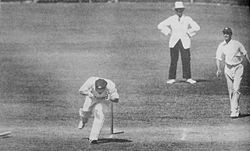
Justice Beech-Jones opened with the account of a matter of some controversy [to some] in cricket history involving the stumping of Johnny Bairstow on 2 July 2023 in a test match between England and Australia that was said to be not in accord with the spirit of the game of cricket.
It was not only a stumping
but “the world as we know it came to an end”.
Despite losing the match, the MCC and the English cricket press claimed a “moral victory”.
After examining the issue in some detail [and his paper includes a video of the stumping], the Judge moved to “bodyline” in the 1930s, a similarly controversial story in the history of cricket.
The rule of law
However, the point of his talk was not cricket itself but rather the rule of law and its lack of support by some prominent and otherwise respected figures in English legal history.
Justice Beech-Jones recounted the well documented opposition to “home rule” in Ireland by Professor A V Dicey whose dubious activities and words, along with those of other eminent legal figures, contrasted much with their expressed writings in favour of the rule of law, and its spirit, and the unwritten constitution of England.
“Like the MCC and the English cricket press, Dicey was very much enamoured with the spirit of things. His discussion of the rule of law consistently invoked the “spirit of legality” or the “legal spirit” pervading the UK Constitution and the institutions of the United Kingdom”, as being a model that “insulates against violence or revolutions”.
But when it came to Ireland, “well, Dicey was a little dicey”.
It would be a disservice to the talk were I to explain much more, and into the present day, but a salient quote or two will assist.
Justice Beech-Jones describes Dicey’s and others’ opposition to Irish home rule as involving
“planning and inciting armed resistance and insurrection”,
and that
“Dicey’s public words were not the ramblings of an academic that no one listened to. They were an important part of a propaganda wall of sound, which has its modern day counterparts”.
During the Irish home rule crisis,
“there was no pretence of constitutionality [those involved being] utterly brazen in their unconstitutional actions and words. They threatened King and the country, and that threat only receded when the First World War threatened everyone”.
Our modern-day counterparts
As to our “modern-day counterparts”, the Judge went on to say that
“right now, many countries, including democratic countries, confront that kind of situation or worse. They are either governed or closed to being governed by similarly venal characters to whom the suggestion of acting in accordance with practices or conventions is a joke; a pathetic sign of weakness.”
A written constitution along with independent courts and other robust institutions can hold off challenges presented by determined unconstitutional actors for a time; although
“if a country breaks bad enough, hard enough and for long enough, nothing can stop irreparable harm”.
But in the case of the UK, a country with an unwritten constitution and only conventions and practices,
“if these venal types control a parliamentary majority and the levers of power in a country with an unwritten constitution and only conventions and practices stand in their way, then what’s worth preserving can be lost in the blink of a parliamentary eye …
Just like a moral victory, the spirit of the Constitution won’t matter much then”.
He then left it to the audience, or the reader
“to judge whether there is any person or group on the United Kingdom’s political horizon who presents such a risk”,
with some oblique suggestions as to who.
Cricket
Justice Beech-Jones did not return to the cricket theme with which he opened.
But the merit of cricket, or any sport, is that it can serve to channel strong and sometimes heated contests between nations away from the often bloody games that our venal characters in the world like to pursue, nevertheless often supported by an equally venal populace.
While there is some commentary seeking to discern positive attributes of cricket playing countries, neither Russia, China nor the United States play cricket.

2 Responses
Sir Edward Carson sat not for a Dublin seat, but for Dublin University – Trinity College – which, like Oxford and Cambridge, used to return MPs in an exercise of plural voting. Its members, who were Unionists, were the only ones to attend the meeting of the House of Commons of Southern Ireland convened to approve the Anglo-Irish agreement that led to the establishment of the Free State.
The humourist and editor of Punch, AP Herbert, was an independent member for Oxford University until the Commons seat was abolished in 1950. The Senate of the Irish Republic has in its current form several seats for the University; these had been transferred from the lower house in the late 1930s.
Excuse my delayed response to your excellent message!