
Spent convictions of insolvency practitioners
According to a report from Stuff in New Zealand, a long-established liquidator has been denied permission to continue to practise based upon his convictions for

According to a report from Stuff in New Zealand, a long-established liquidator has been denied permission to continue to practise based upon his convictions for

The Insolvency Law Reform Act 2016 introduced some, let’s say, novel provisions in relation to the registration and discipline of Australian insolvency practitioners which I

The term ‘ordinary course of business’ in law is meant to describe a transaction that was within the normal operations of a particular business, it

The Australian government is presently finalising its draft SME insolvency law reform proposals. Apart from getting the law right, as significant a task is deciding

Australia proposes to follow England’s lead in giving insolvency practitioners the initial role in new debtor in possession insolvency reforms, but in rather different ways.[1]

Australia’s draft legislation to implement its announced MSME corporate insolvency reforms may have drawn more on international than local thinking, in particular in relation to
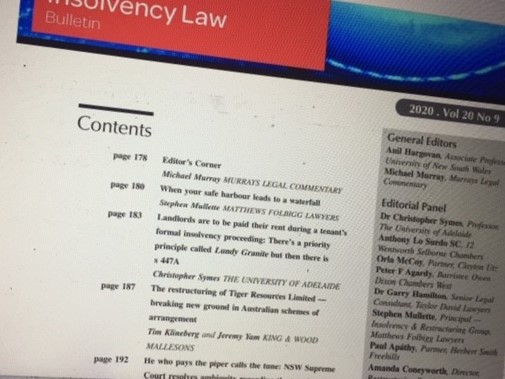
It is interesting to now see the clear limitations the government has placed on the protections offered by the COVID-19 ‘safe harbour’ reforms, in the

Soft law in Australia takes a rather strict approach in assessing the independence of insolvency practitioners, more so than, for example, the UK: for a

The NZ Supreme Court has given a significant decision on the duties of directors in the face of their company’s financial difficulties. Comparison is made

The federal Treasurer has announced a new restructuring regime for struggling small to medium enterprises (SMEs)[1] which adopts a ‘debtor-in-possession’ model for companies owing less

New Zealand has a new insolvency practitioner regulation regime which commenced on 1 September 2020. The regime has processes allowing Australian registered liquidators to be

Commentary following issued in April 2020 is reissued in September 2020 in light of the reports that a significant proportion – close to 55%* –

The Corporations and Bankruptcy Legislation Amendment (Extending Temporary Relief for Financially Distressed Businesses and Individuals) Regulations 2020 serve to extend the existing insolvency protections to

In What has happened to the proposed beneficial ownership of shares register? in February 2020, I asked what has happened to the Australian government’s ”First

In May 2012 a national Australian transportation company was put into liquidation and on 2 July, a meeting of creditors was held which purported to

The Commissioner of Taxation has purchased a litigation claim from a liquidator, on what terms we are not permitted to know. One of the reforms

There is more to insolvency practitioners’ (IP) remuneration than is usually presented, and this commentary explains relevant issues not generally addressed, and in a broader

In what appears to be ominous but necessary preparation for the continued economic consequences of COVID-19, the UK Insolvency Service is seeking insolvency practitioner firms
The latest Insolvency Law Bulletin contains a warning about the (then) ending on 24 September of the COVID-19 protections, now since extended to 31 December.

In Bankrupt for Life, concerning the way a person can remain bankrupt for ever in Australia if they never file their statement of affairs (SOA),

The 1 September 2020 report of the Parliamentary Joint Committee on Corporations and Financial Services on the 2018–2019 annual report of ASIC has pointed out
The Australian government has extended the monetary threshold of A$20,000 for the commencement by creditors of bankruptcy and liquidation proceedings and the 6 month periods

A court has set aside liquidators’ disclaimer of contaminated property on a challenge by the environmental regulator. Particularly in a voluntary liquidation of a company,

The Australian Law Reform Commission report, Corporate Criminal Responsibility (ALRC 136), was tabled in Parliament on 31 August 2020. The 20 recommendations made seek to