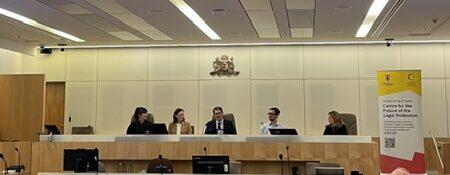
The terms AI, Claude, Dart and more need no introduction nowadays and I could not give it anyway – but an excellent and well informed panel did so in a public discussion held on 20 October 2026, jointly organised by the Australian Academy of Law and the UNSW Centre for the Future of the Legal Profession.
Lawyers in an AI World – Reprogramming Skills, Practice and Education
The panel comprised Dr Kate Booth, head of Capability at Minter Ellison; Professor Genevieve Grant, Director of the Warren Centre for Civil Justice at Monash University; and Gareth Jones, a partner at McKinsey and Co, together with Professor Michael Legg, as provocateur, Director of the UNSW Centre for the Future of the Legal Profession and chaired by Justice Kristina Stern of the NSW Court of Appeal.
New lawyers, private v public, document roles
One inevitable focus was on the future role of new lawyers whose traditional work might be taken over by AI. How those lawyers might develop and the role and impact of AI on their work was discussed, along with how university teaching of law is necessarily changing to adapt. Beyond the large law firms, the position of community and legal aid centres was raised, and issues concerning the imbalance of access to AI. Use of AI in court proceedings, in discovery or document handling and analysis, came up.

Myself with former NSW Chief Justice Mr Tom Bathurst, former Federal Court Judge Dr Kevin Lindgren and recent UTS graduand in law, Ms Grace Ireland.
The expertise and experience and of new lawyers like Grace Ireland, and their on-going use and development of AI, will be central to how AI’s impact on the law is managed.
Decision making
The role of AI in judicial decision making was raised, or any decision making, the response being that human judgment was indispensable to any such process.
Chief Justice comments
As a side comment, in a speech by Chief Justice Stephen Gageler given to the Japanese Judiciary at the Supreme Court of Japan in Tokyo on 3 March 2026, he was asked about AI and judicial decision making.
His response was:
“I fear that there is very little that the judge does that AI cannot do better”.
He went on to say that
“artificial intelligence is artificial reasoning on stilts. I think that it is likely to produce more predictable, equally learned, if not more learned, and fair outcomes than human judges. This is my true fear. What is it that a human can bring to the process that artificial intelligence will not be able to bring to the process either now or in two years? I don’t think there’s very much … My prediction is that civil law practice will probably be overtaken by artificial intelligence very soon”.
I gather the panel would not agree.
He went on to make an exception in the case of the criminal law where
“there is something about the vulnerability, the identification, the humanness of the subject matter, or the object or the person who is to be subjected to criminal liability”.
It is interesting to note the Chief Justice’s use of the word “fear”, twice. Others might say “hope”, that is, that we might have “more predictable, equally learned, if not more learned, and fair outcomes than human judges”.
Human judgment [sic] v AI judgment
As a broader comment from the writer, in the debate about maintaining the ultimate control of human judgment over AI decisions rather than AI judgments prevailing over human decisions, does the state of humanity suggest that human judgment is to be preferred?
The panel did not get to discuss the issues surrounding that question.