I was pleased to have been invited to contribute at two sessions at the AIIP annual conference in Canberra on 23-24 July 2026.
The regulation and responsibilities of insolvency practitioners
One was a discussion on the regulation and responsibilities of IPs, between myself and Professor Jim O’Donovan, well-known academic and author of numerous insolvency texts, chaired and interviewed by Stephen Hathway of the AIIP.

My perspective on the conduct of insolvency practitioners is perhaps more nuanced than others – based on case law – without at all conceding that improper conduct should be regulated.
A point I made was that the role of an insolvency practitioner is quite unique in having both public and private responsibilities, both to be balanced against access to only limited funds: ASIC v Bettles [2023] FCA 975 at [1].
I query the extent to which practitioners are required to attend to public duties in conducting an administration, and the cost, at least without due recognition and transparency.
And as Jason Harris and I say in Keay’s Insolvency, (12th ed imminent), insolvency is not there to offer a panacea for all wrongs or misfortunes arising from the insolvency. To suggest otherwise serves only to reinforce what is sometimes an “expectation gap” about the responsibilities of IPs.
And while a practitioner has statutory duties and responsibilities, these are not open-ended, whatever the ‘guidance’ or ‘expectations’ of the regulators might be.
The courts avoid making any hindsight assessment of an IP’s conduct. It is all very well to be wise after the event in particular when that event can often be a decision made in difficult or high pressure circumstances.
Judgments about a liquidator’s conduct
“must be made in the context of the circumstances as they existed at the time, without the benefit of hindsight [but] with the distinction between negligence and mistakes of error of judgment firmly in mind”: Westpoint Corporation Pty Ltd (in liq) v Yeo [2018] VSC 705.
The courts will generally not query or challenge a trustee’s commercial decision unless it be beyond the bounds of reasonableness.
“Much of a liquidator’s decision-making involves the application of business acumen. That a decision is not fully reasoned or supported by the fullest investigation does not mean that it should be second-guessed by the Court”: In the matter of St Gregory’s Armenian School (in liq) [2012] NSWSC 1215.
Courts respect and understand the commercial and legal decisions required in deciding whether or not to pursue a particular asset or transaction. Pursuing a litigation claim can become questionable when costs mount, but even then the IP’s decision to litigate may be valid: In the matter of Cardinal Group Pty Limited (in liquidation) [2015] NSWSC 1761.
Not pursuing a claim can be a proper decision, even if the creditors direct the practitioner to start proceedings. Insolvency usually involves limited funds, and liquidators should be
“frugal in incurring expenditure. It is usually preferable that scarce resources be preserved for the benefit of creditors and contributories, rather than expended in chasing all hares down every burrow”: In the matter of St Gregory’s Armenian School (in liq) [2012] NSWSC 1215.
IPs can refuse to act on creditors’ wishes. What they must do though is record their reasons for the decision they made: IPS s 85-5(3). In fact throughout an administration it is almost a necessary task, made much easier nowadays with computer generated notetaking.
But as with any profession, there will be IP conduct that goes beyond mistakes of error or judgment, that even without the benefit of hindsight, should not have been taken: Westpoint Corporation Pty Ltd (in liq) v Yeo [2018] VSC 705.

Criminal conduct
Beyond these examples, the panel discussion examined instances of theft of monies from estates. Obviously that is in another category and cannot be condoned although in sentencing the courts may take into account some extenuating circumstances: R v Amos [2024] NSWDC 687.
The ability of a practitioner to take money from an estate seems to be controlled in firms by the requirement for a co-signature. In the case of sole practices, there is need for some higher regulatory approach.
It is not apparent in recent cases what regulatory processes were in place that might have detected these actions, of the industry bodies or the regulators. It seems no-one knew of the theft of the moneys at the time. We should know what went wrong, if anything, if only to learn how to better prevent such conduct.
AI will ultimately resolve this by way of the regulators having direct access to all practitioners’ accounts in real time. See my 2022 article: TIP – The Insolvency Portal.
The AIIP is a well-recognised insolvency body but it is not an “industry body” under the law; nor does it have any disciplinary process. Nevertheless its members are governed by their respective accounting bodies, by APES 330 and by NOCLAR obligations to report misconduct.
Small business insolvency
I was also invited to briefly mention a law reform project jointly being conducted by my QUT colleague Dr Amanda Bull and myself on a combined personal and corporate regime for small business insolvencies; (Amanda spoke on a range of other issues at the conference).
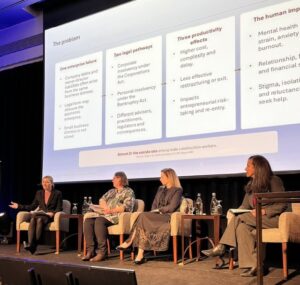
Insolvency law’s strict separation of personal and corporate insolvency has not kept up with the reality of small corporate business structures that combine both personal and corporate assets and liabilities. We are researching proposals and reforms adopted internationally to address that.
Corporate law does not help. Warren & Westbrook said some time ago that
“the much-praised corporate form may be failing a growing number of entrepreneurs. Once heralded for its ability to shield owners from personal liability, corporate form may be meaningless [where] the debts are all personal debts”.
Consideration of the issue has progressed quickly, with Assistant Treasurer Dr Andrew Leigh referring to it in a speech in November 2025, the World Bank inviting us to explain our research in Washington in April 2026, and the Productivity Commission being referred that issue in May among its examination of barriers to business dynamism. A number of submissions to the Commission now raise the issue.
Support for the idea was conveyed to me by AIIP members.
Any comments on our work are invited.
The AIIP Conference
The conference itself was at its usual high standard with presentations and discussions ranging from AML to productivity, to construction insolvencies, to mental health, to personal insolvency, to restructuring and SBR and with attendance by senior people from the Productivity Commission, the ATO, ASBFEO, FEG, ASIC, AFSA, Debt Counselling, Macquarie Bank, DART and the federal Opposition – Mr Tim Wilson and Senator Andrew Bragg.
Senator Bragg was on the 2023 PJC Committee on Corporate Insolvency. The PJC Report is now under consideration by the Productivity Commission in its “business dynamism” inquiry.
;;;;;;;;;;;;;;;;;;;;;;;;;;;;;;;;;;;;;;;;;;;;;;;;;