
The government has referred a productivity inquiry to the Productivity Commission – Regulatory barriers to business dynamism, one factor to be examined being
“the design, operation and integrity of corporate and personal insolvency frameworks, encompassing consideration of whether there are net benefits of greater harmonisation, particularly for small business owners who may need to navigate both systems simultaneously”.
Regulatory barriers to business dynamism – Public inquiry | Productivity Commission
==========
This particular issue comes in part from recommendations of the 2023 PJC Report. More so, it is an issue which is the subject of a current law reform project of Dr Amanda Bull and myself, flowing from her doctoral research, assisted by our recent discussions with the World Bank in Washington. 
Dr Leigh and AFSA have each also raised this issue.
The reference
More broadly, the PC is to examine
“regulatory barriers to business dynamism in Australia, and identify options for reducing these barriers where appropriate, in order to promote innovation, productivity growth and Australia’s international competitiveness”.
The background comments refer to the claim that a
“productive economy relies on regulatory settings that support the constant renewal of business activity. Productivity growth occurs when innovative businesses can enter the market easily, efficient businesses can expand, and unsuccessful businesses can exit quickly”.
It is perhaps odd that the inquiry is negatively focused – regulatory barriers, and options for their reduction – rather than looking at positive ways to promote business dynamism; though perhaps consistent with Australian political and economic discourse.
“Business dynamism” and “creative destruction”
The term “business dynamism” has replaced Schumpeter’s “creative destruction”, a process of exits and entries of businesses in any healthy economy, or churn.
Dynamism is said to rely on entrepreneurs taking risks. But if they fail, there is need for
“predictable and fair regulatory settings ensure that the interests of investors, employees, suppliers, and customers are appropriately protected”.
“Protected” is a charged term – there is little of any financial protection for unsecured creditors in insolvencies.
“But when regulatory settings make exit processes slow or costly, inefficient businesses can remain in the market or exit in an unnecessarily drawn-out way”.
This raises the question whether the threshold settings for voluntary administrations remain suitable – or, “has insolvent restructuring gone too far?”
A single insolvency framework for small business
The need for a single insolvency framework for small businesses, with their interconnected corporate and personal assets and liabilities, has been raised for some time.
More so, it is the subject of a current law reform project of Dr Amanda Bull and myself, flowing from her doctoral research, assisted by our recent discussions with the World Bank in Washington. 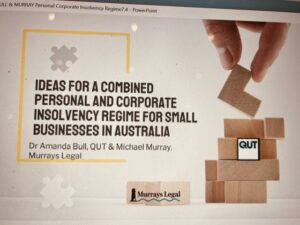
As said earlier, Dr Leigh and AFSA have each also raised this as an issue of law reform.
This topic is to factor in whether such reforms would “support the efficient allocation of resources across the economy in a manner that preserves system integrity and deters corporate misconduct”. A balance is required.
The PC to support its analysis with economic modelling. See The economics of insolvency – the pain of liquidation is one way to get economic growth – Murrays Legal
Oddly, the government asks for a review of the operation of the Treasury Laws Amendment (Combatting Illegal Phoenixing) Act 2020. Here are some [negative] thoughts: The new law’s limitations in controlling phoenix misconduct – Murrays Legal
Also, the tax, workplace relations, and mergers frameworks are not intended to be the focus of this inquiry. [I have said that the tax laws support the insolvency system; and that tax is in effect a de facto regulator of the insolvency system – see Murray, The ATO as an insolvency regulator, 2007].
Report due May 2027
The Commission should deliver a final report within 12 months preceded by an interim report. The final report for this inquiry should include advice on reform implementation, including implementation feasibility and risks, and areas where more evidence is needed to inform future evaluations.
Comments
Necessarily, my views on this are brief, and will be considered further.
Some quick comments are:
- The Productivity Commissions’ 2015 report contained a number of insolvency recommendations, some or many of which were not implemented. This inquiry may revisit those.
- The 2023 PJC report is not mentioned but its various recommendations should be considered: see Bull and Murray, Insolvency Law in 2025: its present operation, its reform and its future, 2025.
- Economics based and systems modelling may confirm that there are not enough remaining moneys or assets in insolvent estates to fund the system. A government role may be need: see Murray & Harris – Rebuilding the Structure of the Australian Insolvency System, 2022.
- Given the nil or limited returns to creditors overall, the ILRA 2016 reforms in support of creditor involvement in insolvencies may need to be revisited. Similarly, the regulatory emphasis on wrongdoing may also need revisiting as being cost ineffective. AI may assist. See Murray & Harris – Rebuilding the Structure of the Australian Insolvency System, 2022.
- Resolving the tension between competition principles and insolvent restructuring is central to productivity: see Murray, The interaction of insolvency law and market competition, 2025.
- Among my many website comments since 2016, this last one offers high level ideas on reform. Insolvency law reform – some views – Murrays Legal
- And from the past: Insolvency law’s elephants in the room – Murrays Legal
More soon.