
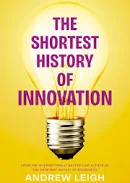
I was pleased to have attended the launch of The shortest history of innovation by Dr Andrew Leigh MP at the University of Sydney on 19 February.
The book is an entertaining and informative and thoughtful account of the benefits of innovation in our lives, indeed for humanity, and how they have occurred, with themes of inventions happening quickly or after some or months or years of research, those based on gender, or location, and their respective impacts.
Dr Leigh is the Assistant Minister for Productivity, Competition, Charities and Treasury. Within those responsibilities, he is responsible for corporate and as of recently, personal insolvency.
Insolvency
While it may seem perverse to raise insolvency as a connection, there is in fact much literature to support the relevance of good insolvency laws in encouraging innovation, in offering a prompt resolution of what can be the inevitability of failure and financial loss; while severe consequences of failure, inevitable in any pursuit of new ideas, will be a dampener.
In a recent talk, at the AFSA Summit in November 2025, Dr Leigh spoke in favour of the personal insolvency system in helping determine whether people are willing to start businesses, employ staff and seek credit, and in the context of it supporting innovation. He says it allows people to take risks, knowing that if things go wrong, there is a fair and lawful framework to resolve the outcome. It allows those who have experienced business failure to re‑enter the economy and contribute again.
The World Bank which sets guidance across jurisdictions on insolvency laws emphasises the connection with innovation. It sees merit in early discharge for those having been through bankruptcy; or the demerit of a long waiting period before discharge, which could result in the entrepreneur being unable or unwilling to re-enter the market productively. A recent World Bank report cites several studies that have shown a strong connection between a country’s personal insolvency laws and entrepreneurship: The Economic Impacts of Insolvency Regimes, Menezes and Gropper, 2025.
Australia
These are all inspiring words but the reality of our insolvency system in Australia may not quite match them. A parliamentary joint committee report of July 2023 was critical of the corporate insolvency regime and made substantial recommendations and a further recommendation for a more comprehensive examination of both personal and corporate insolvency. It has not received a government response.
The World Bank is itself reviewing Australia’s corporate insolvency laws this year, and other business laws, under its new B-Ready process. How Australia compares with other comparable jurisdictions will be noted.
Our present bankruptcy laws are no better. They are much embedded in a culture going back to Roman times when a person unable to pay their debts was branded infamous, infamia, grouped with dishonourable military discharge, familial ‘misbehaviour’ and bigamy, in effect a “civilian death penalty [as] an outcast in … society …”.[1]
There is some remnant of this in the labelling imposed under our bankruptcy law, and beyond. In Australian statute law, the term “bankruptcy” is often listed with criminal conduct including treason,[3] money laundering, armament dealings and espionage.[4]
Necessarily we have moved on, even past the colony of Victoria being one of the last jurisdictions in the world to support debtors’ prisons,[2] but we need to move further.
National culture is important. Some may recall the lipstick queen, Poppy King, whose successful cosmetics business in Australia in the 1990s ultimately collapsed. She went to the US and succeeded.  She was critical of her experience in Australia and in comparison, was reported as saying that in the US,
“if you haven’t been in Ch 11 (bankruptcy) you’ve never been in business”: Insolvent Words (2001) 2(1) INSLB 2.
Whether connected with our standing, the Dr Leigh’s book does not record innovations by country, and Australia’s contributions in lipstick, as well as Victa lawnmowers and Hills Hoists, are not mentioned.
The book is published by www.blackincbooks.com
The launch
Dr Leigh’s responses to a wide range of informed questions at the launch, moderated by Mark Scott, Vice Chancellor and PresidentUniversity of Sydney, were informed, thoughtful and entertaining. The book is likewise an excellent read.
============================
[1] In search of what constitutes insolvency law, ECCL 4/2024 369 at 377, Christoph G. Paulus. See also footnote 22.
[2] Contrary to the Spirit of the Age: Imprisonment for debt in Colonial Victoria 1857-90, Boyd, Ramsay and Ali, [2019] 42(3) MULR 737; Three year ‘imprisonment’ for bankruptcy debt – Murrays Legal
[3] Bankruptcy, Treason and Other Crimes, M Murray [2001] 1 INSLB 138.
[4] Crimes Act 1914, s 15GE Meaning of serious Commonwealth offence and serious State offence that has a federal aspect.