With Treasury now comprising Ministers well qualified in economics,[1] and with a government focused on competition, economic dynamism and productivity, any reform of insolvency laws may take a new direction. This is reinforced by the transfer of personal insolvency to Treasury, so that both personal and corporate insolvency come within the one department. Related areas of tax, small business, and competition also usefully fall under Treasury. However, that economic and productivity focus may begin to question existing insolvency laws and processes and their reform.
Key words
Given the length of this, here are some key words: small business, insolvent small business, AFSA, ASIC, productivity, competition, DART, business dynamism, Schumpeter, Dr Leigh, Dr Aly, horse economy, OECD, Part 5.3B, regulation impact statements.
Small business
‘Small business’ is now handled by the Hon Dr Anne Aly MP, as Minister for Small Business, for International Development, and for Multicultural Affairs. She has recently spoken about the role and input of the small business sector in the economy[2] and about the wide diversity of services and goods that it provides. She explained that it comprises 70% of mostly sole traders with only 30% of businesses being incorporated.
The term “small business” is very relevant in some contexts, but less so in others. The Fair Work Ombudsman has been charged with redefining a “small business employer” which presently is an employer employing fewer than 15 employees,[3] relevant in relation to the extent of coverage of employee conditions.
The ASBFEO’s definition in its legislation is a business with under 100 employees, or under $5 million in revenue. Tax laws define a small business in terms of aggregated turnover of under $10 million.[4]
Some use the term loosely, including academics, as if you should know a small business when you see it.
Insolvent small business
Perhaps only when the business fails does the legal definition cut through and come to the fore revealing what entity we are talking about, that is, what the legal structure actually comprises. That structure should be known to the business owners but they don’t always or rarely conduct their business in the neat and structured way of the law. Despite operating through a company, personal liabilities are often assumed such that “the corporate vs non-corporate distinction in assets and liabilities is often blurred” with personal insolvency regimes often being the more relevant for small businesses. The design of personal insolvency regimes is also relevant in shaping the efficiency of corporate regimes.[5]
The legal reality is such that with the inevitable and continual failure of small businesses, insolvency law offers separated processes depending on whether a business is in Dr Aly’s 70% or her 30%, or both. That is, if the business is conducted through a company, then the Corporations Act applies. If a sole trader, then the Bankruptcy Act applies. Their harmonisation was only partly addressed by the ILRA 2016 reforms.
The 70%
As to the 70%, insolvent sole traders have the option of bankruptcy under the Bankruptcy Act, for at least 3 years, say until 2028; or a Part X agreement which averages around 18 months. The numbers of “business bankruptcies” are low but sit at around 40% of all bankruptcies.
The 30%
As to the 30%, company owners might have their company put into liquidation under the Corporations Act, or Part 5.3A administration or Part 5.3B small business restructuring, or simply let the company go into deregistration. Even then, there is confusion in terms: a “small business restructure” under Part 5.3B of the Corporations Act in fact refers to a small corporate business restructure; personal liabilities of the owner are specifically excluded. The numbers of corporate insolvencies are relatively steady.
These separate processes of insolvency lend themselves much to productivity improvements, as the 2023 PJC Report on Corporate Insolvency suggests.
Regulation, courts, states
Then there is the separated regulation. AFSA regulates personal insolvency, and hence regulates small businesses operating outside corporate protection, and bankruptcy trustees and administrators. ASIC separately regulates small businesses operating through companies, and liquidators in their various roles. A small business with a blended approach is regulated by both ASIC and AFSA. Professional regulation by legal and accounting bodies completes the structure.
Outside Treasury, employees caught up in an insolvency are attended to by the Fair Entitlements Guarantee Scheme (FEG) under the Department of Workplace Relations (DEWR). DEWR is trying to improve law to protect or enhance its rights of recovery from those who abuse the FEG scheme.
Courts and their jurisdictions remain within the Attorney-General’s Department – hence that personal insolvency is handled by the Federal Court and the Federal Circuit and Family Court (Div 2), except that the Federal Circuit and Family Court (Div 2) cannot take UNCITRAL Model Law cross-border insolvency matters; and corporate insolvency is handled by the Federal Court and the Supreme Courts and lower courts of the States and Territories, but not the Federal Circuit and Family Court (Div 2).
Then there are the laws of the states and territories.
These other agencies, federal and state, will no doubt maintain a connection with Treasury in relation to insolvency law issues.
Productivity and Competition
Apart from Dr Aly, Dr Andrew Leigh is the Assistant Minister for Productivity, Competition, Charities and Treasury.
As to those areas, insolvency cuts across competition and productivity – the more competition and economic dynamism, the more insolvencies. The more the government intrudes upon that process – for example under Part 5.3B – the fewer liquidations and a reduction in dynamism.
The greater the bankruptcy restrictions imposed on sole traders, the less enterprise.
The importance of sound insolvency frameworks for business dynamism, economic renewal and productivity is reported as being increasingly recognised internationally, as explained in the OECD’s Enhancing Insolvency Frameworks To Support Economic Renewal.[6] The OECD has also analysed corporate and personal insolvency regimes, “in terms of their goals, optimal design (including trade-offs) and key features” relevant to productivity, with design features of insolvency regimes relevant to productivity.[7]
In reference to business dynamism, Dr Leigh has referred to the older term, that of Joseph Schumpeter’s ‘creative destruction’, whereby competition or market changes force out less efficient businesses in favour of new more efficient and innovative firms.
The horse economy
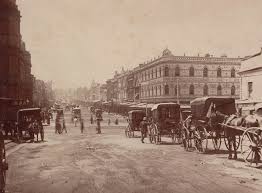
In Dr Leigh recounting the history of Melbourne transport, the 20,000 horses needed for transport “created a need for a vast horse economy consisting of blacksmiths, ironmongers, saddlers and tack or feed merchants” and more, whose jobs were lost when the motor car arrived. Those who had serviced the horse economy had to reskill and adapt, putting “destructive” strain on society but also “creating” new opportunities.[8] Insolvency productively served that process by liquidation of the failed businesses and reallocation of their remaining assets.
Treasury will no doubt see the modern-day relevance of that in bringing a business dynamism focus to insolvency law reform.
Principles and objectives of insolvency law
The 2023 PJC Report’s recommendations 1-3 included a comprehensive and independent review of Australia’s insolvency laws, encompassing both corporate and personal insolvency, and as an early task, to consider and report on the appropriate principles and objectives of insolvency law. Options to enhance public interest objectives and the effectiveness of, and interaction between, the personal and corporate insolvency systems, were also recommended.
With insolvency now within Treasury’s more economics focused brief, those principles and objectives might look more to the place that both personal and corporate insolvency have in the economic system, while still retaining its important law-based principles. For example, there is the issue whether insolvency law imposes the costs of too many public interest tasks on creditors in investigating corporate misconduct might be examined.[9]
The role of insolvency prompting or facilitating business ‘exits’ might be seen more as an inevitable and necessary consequence of a dynamic market economy, rather than as a crisis to be pored over. The contribution of firm exits to aggregate productivity growth is said to be significant, with low productivity growth stemming from “weak market selection, whereby inefficient firms increasingly linger – as opposed to exit – the market”.[10]
Nevertheless, such increases in entry and exit rates are not necessarily good for productivity and consumer welfare. Rather, there is an “optimal level of entry and exit in an economy as both entry and exit, and the forces underpinning them, incorporate both benefits and costs”.[11]
None of this distracts from the need for attention to proper legal processes.
Impact of new legislative measures on competition and economic dynamism
The 2024 House of Representatives report on Better Competition, Better Prices Report[12] has recommended that the government consider strengthening the guidelines in relation to Regulatory Impact Statements (RISs) so that they more explicitly include consideration of the impact of new legislative measures on competition and economic dynamism.[13] That would require more data to explain and justify the legal operation of insolvency, data which is always and presently lacking.
Looking back, the RIS on the Part 5.3B reform processes,[14] described by then then government as “the most significant changes to the Australian insolvency framework in almost 30 years”,[15] was assessed by the Office of Best Practice Regulation (OBPR) as only ‘adequate’ in terms of the Australian Government’s RIS requirements, and “not consistent with good practice”.
The RIS “would have benefitted from an appropriate level of consultation on all of the proposed policy options to enable more robust impact analysis”.[16]
Whether similar such expedient insolvency reforms, or their extension, would be approved in the new light of a renewed focus on competition and economic dynamism is to be anticipated. A greater focus on the need for an explanation of the economic benefits of any future insolvency reforms may develop.
Overall
While it is not expected that insolvency could be confined to one department, given the breadth of its coverage, the fact of both personal and corporate being within Treasury is a good start in achieving increased harmonisation and connections with broader social and economic interests, despite some entrenched law and perceptions.
These are issues well within the expertise of Treasury to manage.
===========================================
[1] Ministers | Treasury.gov.au
[2] Interview with Patricia Karvelas, Afternoon Briefing, ABC | Treasury Ministers
[3] Fair Work Act 2009 s 23
[4] Income Tax Assessment Act 1997 – section 328.110 Meaning of small business entity
[5] OECD Economics Department Working Papers No. 1309 Insolvency Regimes and Productivity Growth: A Framework for Analysis, Müge Adalet McGowan & Dan Andrews, ECO/WKP (2016) 33.
[6] Enhancing Insolvency Frameworks to Support Economic Renewal, Economics Department Working Papers No. 1738 Christophe André and Lilas Demmou, December 2022.
[7] OECD Economics Department Working Papers No. 1309 Insolvency Regimes and Productivity Growth: A Framework for Analysis, Müge Adalet McGowan & Dan Andrews, ECO/WKP(2016)33.
[8] Address to International Small Business Summit, Melbourne | Treasury Ministers
[9] See Rebuilding the structure of the Australian insolvency system, M Murray & J Harris, (2022) 22(1&2) INSLB 14
[10] Insolvency Regimes and Productivity Growth: A Framework for Analysis, OECD Economics Department Working Papers No. 1309 by Müge Adalet McGowan and Dan Andrews, ECO/WKP (2016) 33.
[11] Productivity Commission submission, March 2023, to the House of Representatives Inquiry into promoting economic dynamism, competition and business formation, March 2023.
[12] Better Competition, Better Prices Report on the inquiry into promoting economic dynamism, competition and business formation House of Representatives Standing Committee on Economics, March 2024
[13] Better Competition, Better Prices Report on the inquiry into promoting economic dynamism, competition and business formation, House of Representatives Standing Committee on Economics, March 2024
[14] Treasury to OBPR 27 November 2020 enclosing its Regulation Impact Statement – Insolvency reforms to support small business.
[15] Fact Sheet, Insolvency reforms to support small business.
[16] OBPR 3 December 2020. A recent and detailed review of the objectives of the
SBR regime and of the views of practitioners, with recommendations for improvements, is contained in Small to Medium Enterprises: Destined to Fail or Supported to Thrive? A Critical Analysis of the Australian Restructuring Framework as it Relates to Small to Medium Sized Enterprises, Amanda Jayne Bull, PhD thesis, Queensland University of Technology, 2025.