
Productivity inquiry into phoenix activity

The Productivity Commission (PC) has issued its National Competition Policy: modelling proposed reforms. Among proposed inquiries into electric vehicle charging and marine freight is an inquiry into phoenix activity. This is in the context of the government undertaking a two-year competition review. A key focus of the review is to ‘look at competition laws, policies […]
Courts’ statistics on their delayed judgments

As a 2025 postscript to my comments below, while it will often be difficult to anticipate the time that litigation commenced by an insolvency practitioner will take – ranging from directions to a determination of claims, it should be assumed that a decision from the court will be provided within an acceptable period. Statistics of […]
ASIC updates “guidance to help directors prevent insolvent trading”

ASIC has updated its regulatory guide for directors and their professional advisers on the duty to prevent insolvent trading – s 588G Corporations Act – and has provided new guidance on the safe harbour provisions – ss 588GA-588HA. RG 217 ASIC says that the updates to Regulatory Guide 217 Duty to prevent insolvency trading: Guide […]
A confused director

A challenge to a winding up demand served on Lifestyle Homes (ACT) Pty Ltd over the omission of the words ‘of court’ went through 5 adjournments before being dismissed. Mr Espinoza was the sole director of a company – Lifestyle Homes (ACT) Pty Ltd – that owed the ATO in excess of $4m. A […]
A further continued fall in personal insolvencies

Following my October 2024 report, below, that personal insolvencies dropped in number in each of July, August and September 2024, AFSA has now reported the numbers have continued that fall, if only slightly, in October 2024. Provisional personal insolvencies decreased in October 2024 | Australian Financial Security Authority In October 2024, there were 1,009 new […]
Not a skerrick …..

An Australian judge used the unusual word ‘skerrick’ recently, which means “a small piece or quantity” – as in “the absence of a skerrick of evidence to the contrary”.[1] The word is said to have originated in Great Britain in the early 1820s as a slang term for halfpenny.[2] Nowadays it is said to be […]
Personal insolvency numbers

AFSA has reported that personal insolvencies increased in the September quarter 2024 compared to September quarter 2023. That is, there were 3,307 new personal insolvencies in the July-September 2024 quarter, up by 199 from 3,108 in September 2023. Personal insolvencies up in September quarter 2024 | Australian Financial Security Authority Of the September quarter 2024 […]
Insolvency and competition law – two disciplines moving as parallel universes, without coordination

“Ultimately, it seems that the two disciplines move as parallel universes, without any coordination …”. Only “by linking the attempt to restructure the company in crisis to a strict review it is possible to compose the principles underlying the insolvency and competition law into a more coherent system”. businesses that do not comply with their […]
Are pecuniary penalties actually paid?

One enforcement tool of regulators is to obtain a court ordered civil penalty against the respondent company or individual. That then allows the regulator to apply to the court for a ‘pecuniary penalty’ to be imposed. This is ‘a monetary penalty imposed by courts in civil matters where a contravention of a civil penalty provision […]
AFSA’s annual report on personal insolvency?

The AFSA 2023–24 Annual Report has been released, reporting on the information required under particular public sector legislation. Unlike ASIC, AFSA is not required to, and does not, report on particular insolvency matters of interest: see s 136(1)(ca) ASIC Act 2001. While the Inspector-General in Bankruptcy is simply required under section 12(1) of the Bankruptcy […]
Litigation Funding in Insolvency and in Class Actions

This queries corporate insolvency’s requirement for approval of liquidators’ litigation funding in the context of an article comparing litigation funding of insolvency claims and of class actions Over some period of time, I have queried why more law reform and other attention is not given to the connection between funding of class actions and funding […]
Insolvency law reform – and income contributions

A 1997 article about the need for data in insolvency law reform, rather than relying on assumptions and anecdotes unsupported by empirical research, remains as relevant today as then. In a recent case, involving a 2017 bankruptcy discharged in 2020, the Federal Court found that the former bankrupt had received free legal services which constituted […]
Insolvency practitioner remuneration – continued ….

A report in a daily newspaper[1] has commented on the large fees earner by liquidators and administrators in attending to the collapse of some large enterprises, airlines included, in particular those subject to Part 5.3A administration. Without commenting on the particular companies referred to, some perspective always needs to be given to comments about insolvency […]
What is the future of insolvency practice?
In my reply to an interesting comment from a practitioner about the fundamental difficulties of lack of funding for insolvency work, I extracted my commentary of 2021 below about the potential for artificial intelligence (AI) and its offshoots to play an increasing role in insolvency practice. While there will be developments in the past 3 […]
Annotated Bankruptcy Act 10th ed, 2024, LexisNexis
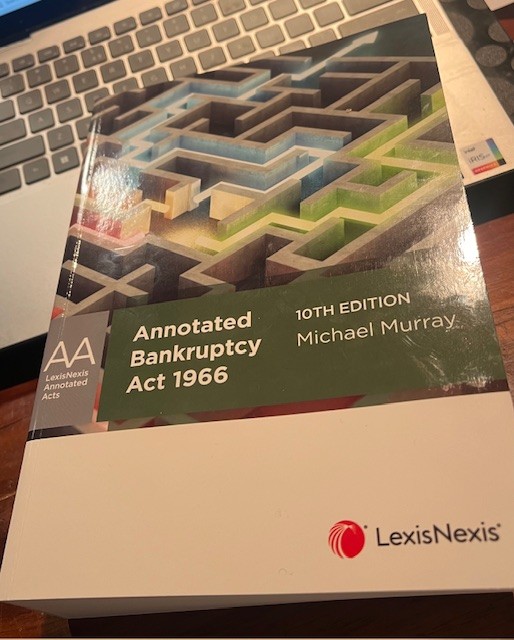
Annotated Bankruptcy Act 1966, 10th edition I am pleased to have had published the 10th edition of the Australian Annotated Bankruptcy Act 1966 by LexisNexis. This work follows on from the considerable input to the book made by the late Paul Nichols whose contribution is readily acknowledged. The book is extracted from Practice and Procedure […]
ASIC’s annual report 2023-2024 – Chapter 5 insolvency issues

ASIC has released its 2023-2024 annual report. ASIC annual reports | ASIC. Under s 136(1)(ca) of the ASIC Act 2001, it is required report on its activities under Chapter 5 of, or Schedule 2 to, the Corporations Act and related provisions. Various issues raised in the report continue to remain the subject of recommendations by […]
The need for a new process for the appointment of insolvency practitioners?

A Judge has expressed concern about the processes for the appointment of insolvency practitioners, suggesting adverse relationships with their lawyers, leading to an abdication of adherence to their duties by practitioners in favour of the pursuit of a “profitable administration”. There is much law and policy background as to issues of independence, remuneration and professional […]
Insolvency trends – should they be higher?

Recent figures show trends in insolvencies in Australia – nothing too significant at a macro level though distressing at a personal level. But perhaps they could or should be higher? in 2023-2024, personal insolvencies totaled around 11,600 compared with 37,000 15 years ago. corporate insolvencies totaled about 11,000 out of 3.4 million companies, slightly higher […]
ASIC’s updated guidance on liquidator registration and discipline; AFSA; and the ART

ASIC has released updated regulatory guidance on statutory committee registration and discipline processes, and related issues: see Revised Regulatory Guide 258 Registered liquidators: Registration, ongoing obligations, disciplinary actions and insurance requirements (RG 258). AFSA provides similar guidance. Reviews of committee decisions will be heard by the new Administrative Review Tribunal from 14 October 2024. This is […]
Gender balance in the insolvency industry

With women comprising only around 10% of insolvency practitioners, the issue of gender balance continues to receive attention, among broader issues of diversity in that sector, and in the workforce generally. The Turnaround Management Association (TMA) has recently launched its TMA Voluntary Code for Equitable Insolvency & Restructuring Appointments (EIRA) under which a Code adopter […]
Reviewing liquidators – under review?

ASIC has announced that it has appointed 15 new members to its Reviewing Liquidator Panel, following the expiry of the 5 year terms of the previous panel members.[1] ASIC can appoint a registered liquidator to act as a reviewing liquidator to a company in external administration under section 90-23 of Schedule 2 of the Corporations Act […]
Coercive control and insolvency

ASIC has asked registered liquidators to “stay alert” for signs of family and domestic violence when conducting insolvency administrations.[1] ASIC explains that any behaviour that is violent, threatening, controlling, or is intended to make a person or that person’s family feel scared and unsafe, can be considered as family and domestic violence. An aspect of […]
Fees of insolvency practitioners and lawyers

The commentary following was issued on 15 August 2021. It is reissued for historic interest only, perhaps, on the assumption that fee relations between lawyers and IPs have improved in the ensuing three years? After Jason Harris and I wrote about Justice Michael Lee’s comments on the high charge out rates of insolvency practitioners, I […]
Personal insolvency figures up and ‘reforms’ pending

Personal insolvencies increased in July 2024, to 1157 compared with the lows of 851 in June 2024, and 929 in July 2023, according to new provisional monthly statistics released by the Australian Financial Security Authority (AFSA). That’s about .0064% of the adult population. The government’s proposed law reforms include to allow debtors to have 7 […]